7 Years Building Funding Apps for Danish Universities
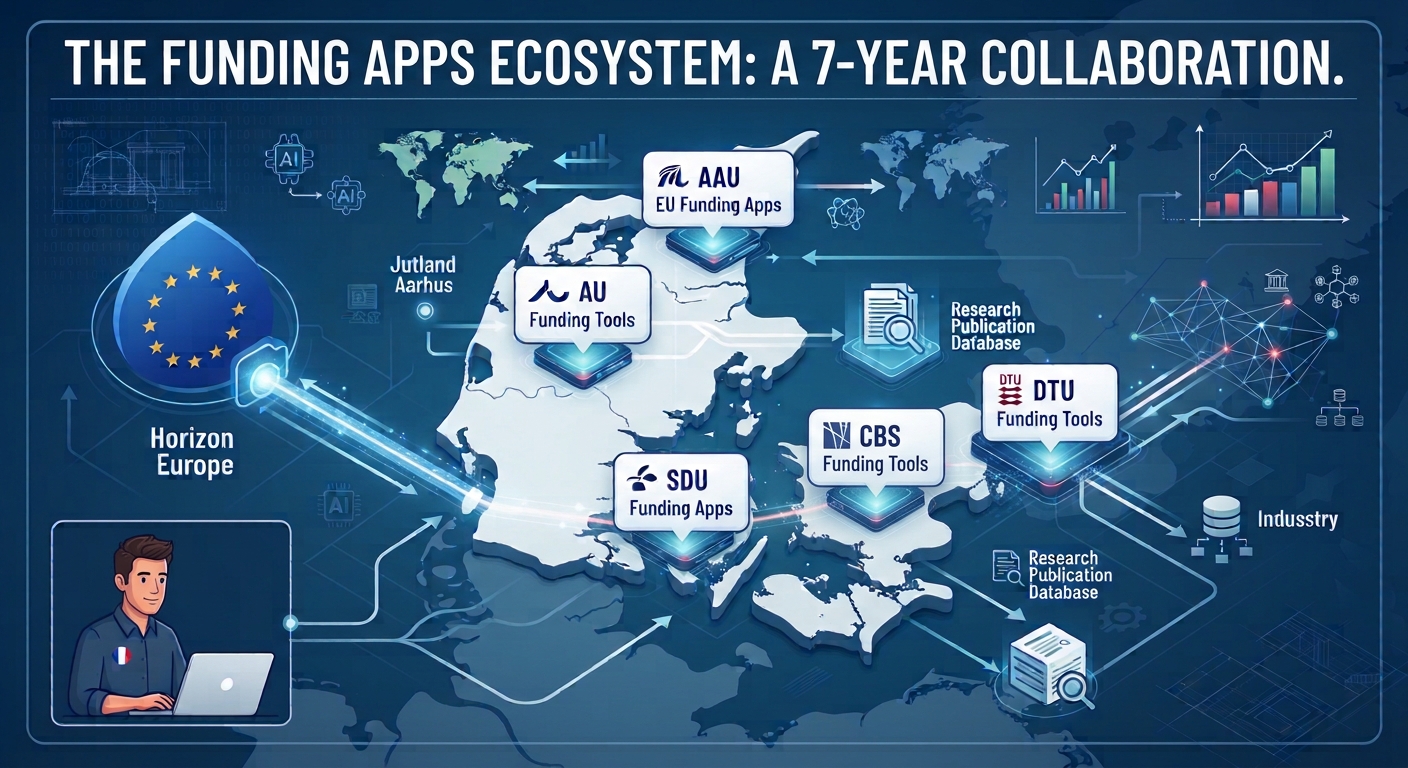
How an independent French senior full-stack developer spent seven years building AI-powered research funding tools for Danish universities
-
How 7 Years of Collaboration with Danish Universities Built the Funding Apps Ecosystem
- The Genesis: Scaling from One University to a National Standard
- Under the Hood: 4 Micro-Apps for Smarter Grant Matching
- The Full-Stack Reality: Five Disciplines in One Codebase
- Beyond the Code: A Genuinely Multidisciplinary Experience
- From Solo Developer to Tech Lead: A Team Grows Around the Vision
- The Freelance Advantage: Agility Meets Long-Term Vision
- The Road Ahead
How 7 Years of Collaboration with Danish Universities Built the Funding Apps Ecosystem
As an independent French senior full-stack developer, I am often asked what makes this long-running collaboration with Danish universities work so well. My honest answer, after seven years, comes down to a rather uncommon combination: continuity, deep domain expertise, and trust, backed by a set of skills and experience that few single profiles bring together.
For the past seven years, I have worked hand-in-hand with the research support departments of Denmark’s leading universities. Together, we have transformed academic grant acquisition — a process historically bogged down by administrative complexity — into a streamlined, automated ecosystem of interconnected research funding applications.
This is the story of the Funding Apps suite: a piece of software craftsmanship, built specifically for Danish academic excellence.
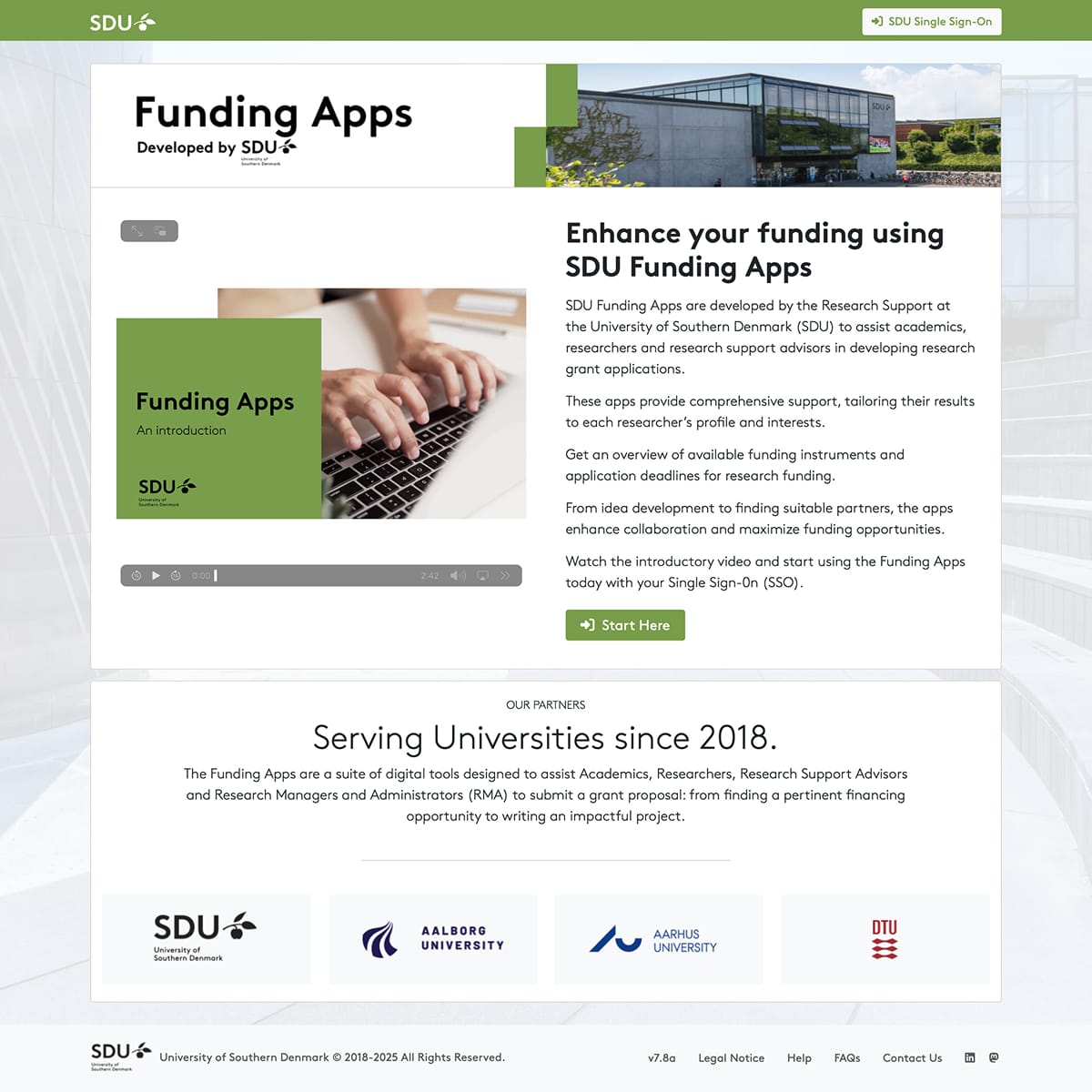
The Funding Apps were first deployed at the University of Southern Denmark (SDU) in 2019.
The Genesis: Scaling from One University to a National Standard
It all started in 2019 at the University of Southern Denmark (SDU) in Odense. Maéva Vignes from SDU Research and Innovation (RIO), conceptualized the first version of the Funding Apps — a suite of digital tools designed to streamline research funding, from finding a pertinent financing opportunity to writing an impactful proposal.
Maéva is a French PhD researcher who was working as a funding advisor at SDU. Maéva had stood on both sides of the table: as a researcher writing competitive proposals, and as an advisor guiding colleagues through them. Her creative mindset — grounded in rigorous science but focused on practical researcher needs — defined the philosophy of the Funding Apps from day one: solve the real pain, not the administrative surface.
The initial challenge was ambitious: how could we help busy researchers instantly discover European grant opportunities (such as Horizon Europe) tailored to their exact research track, without forcing them to manually comb through thousands of pages of administrative text?
By combining a highly resilient infrastructure with Natural Language Processing (NLP) pipelines, we built a suite of tailored, AI-powered research funding micro-applications. The platform’s success at SDU quickly caught the attention of other major institutions across the country, leading to a nationwide expansion.
| Since | Institution | Platform |
|---|---|---|
| 2019 | University of Southern Denmark (SDU) | SDU Funding Apps |
| 2022 | Aalborg University (AAU) | AAU EU Funding Apps |
| 2025 | Aarhus University (AU) | AU Funding Tools |
| 2026 | Technical University of Denmark (DTU) | DTU Funding Tools |
| 2026 | Copenhagen Business School (CBS) | CBS Funding Tools |
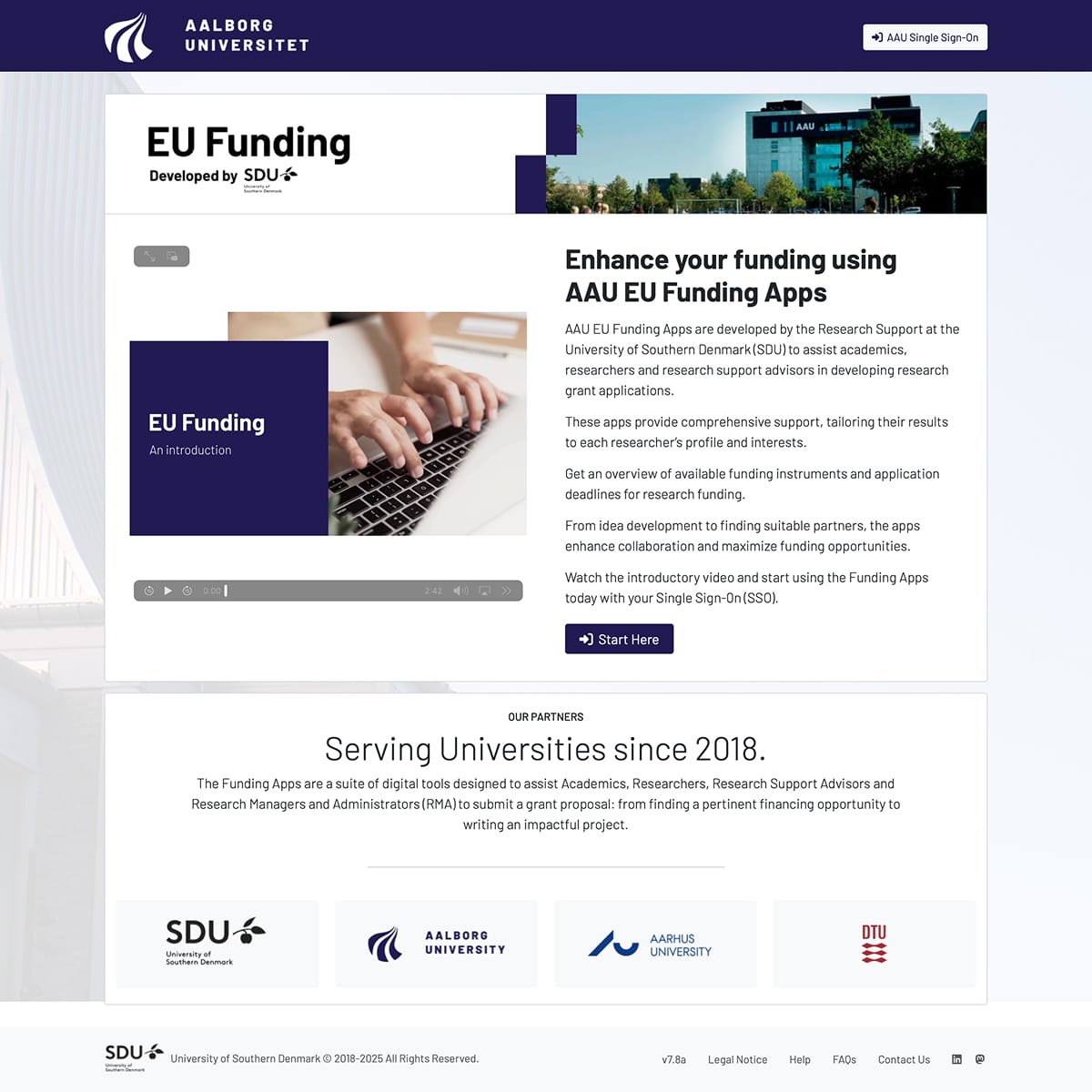
Aalborg University (AAU) was the second Danish university to adopt the AAU EU Funding Apps in 2022.
Under the Hood: 4 Micro-Apps for Smarter Grant Matching
Building software for the academic sector demands strict precision. To maximize pre-award success rates, Maeva and I architected the ecosystem around four specialized modules that execute data updates overnight:
- EU Call Finder: A text-mining algorithm that parses a researcher’s publication history to automatically suggest the most relevant Horizon Europe calls.
- EU Projects: A semantic mapping tool that scans existing EU-funded projects, ensuring a researcher’s proposal is fully novel before they invest months into writing it.
- EU Partners: A network-graph recommendation engine that maps pan-European corporate and university connections to find missing stakeholders for a strong grant consortium.
- EU Evaluators: A profile-matching module that aligns the thematic focus of a draft proposal with past EU reviewers, identifying internal faculty contacts for mock peer reviews.
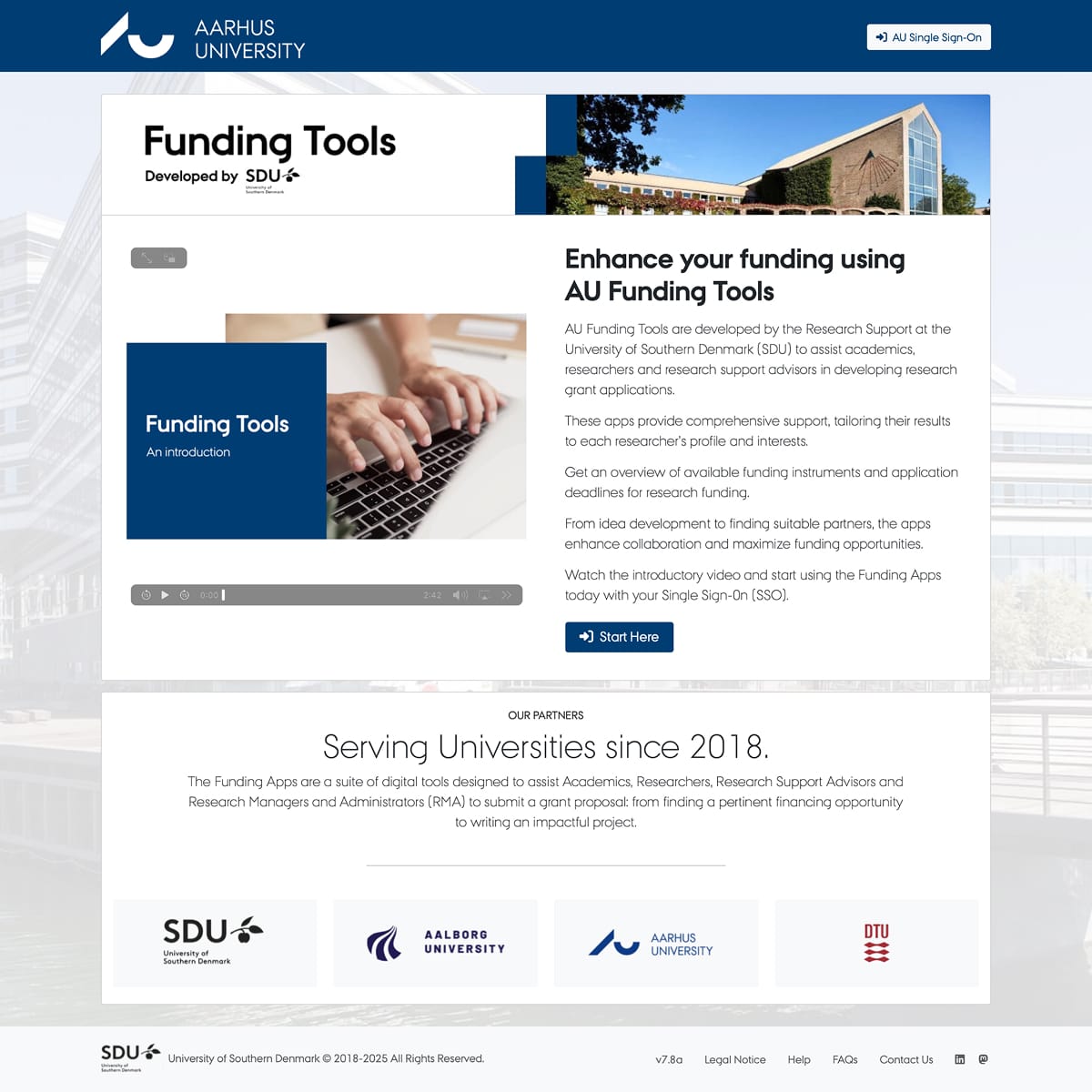
Aarhus University (AU) was the third Danish university to adopt the AU Funding Tools in 2025.
The Full-Stack Reality: Five Disciplines in One Codebase
People often assume “full-stack” is a marketing label. The Funding Apps suite is a concrete demonstration of what the term truly demands. A single glance at the project’s dependencies reveals five distinct engineering disciplines that one person must command simultaneously:
Back End Engineering
The server side is anchored on a mature Django application, with scheduled batch jobs orchestrated nightly, enterprise-grade authentication wired into the universities’ Microsoft identity stack, and secrets and storage delegated to Azure Key Vault and Azure blob services. Reliability engineering — caching, memoization, error resilience — is woven through every layer, because grant deadlines do not tolerate downtime.
Database Engineering
Underneath sits a PostgreSQL core with connection pooling, bulk import and export pipelines, and carefully tuned query patterns. The data model must reconcile heterogeneous sources — publication records, grant calls, funded-project portfolios — into a coherent schema that can answer a researcher’s question in milliseconds.
Front End Engineering
The user-facing layer follows a rigorous build chain — webpack, Sass, and minification pipelines — serving Bootstrap 5 interfaces styled to each institution’s identity. Interactive data tables, full-scale calendar views of upcoming calls, search panes, and rich charting libraries must all feel instant and effortless, in keeping with Scandinavian design minimalism.
ETL and Data Cleaning
Raw funding data arrives in every conceivable condition: HTML pages, PDF documents, Excel spreadsheets, compressed archives. An entire extraction-transformation layer — scrapers, PDF and spreadsheet parsers, browser automation, language detection, and Unicode normalization — runs nightly to turn that chaos into clean, structured, matchable records.
Natural Language Processing
Finally, the intelligent layer that ties it all together: NLP and machine-learning libraries that tokenize, lemmatize, and vectorize publication abstracts and call texts, then use semantic similarity and fuzzy matching to connect the right researcher with the right opportunity. This is the engine behind EU Call Finder, EU Projects, EU Partners, and EU Evaluators.
Five disciplines. One developer. That is the bar this project has set — and maintained — for seven years of continuous releases.
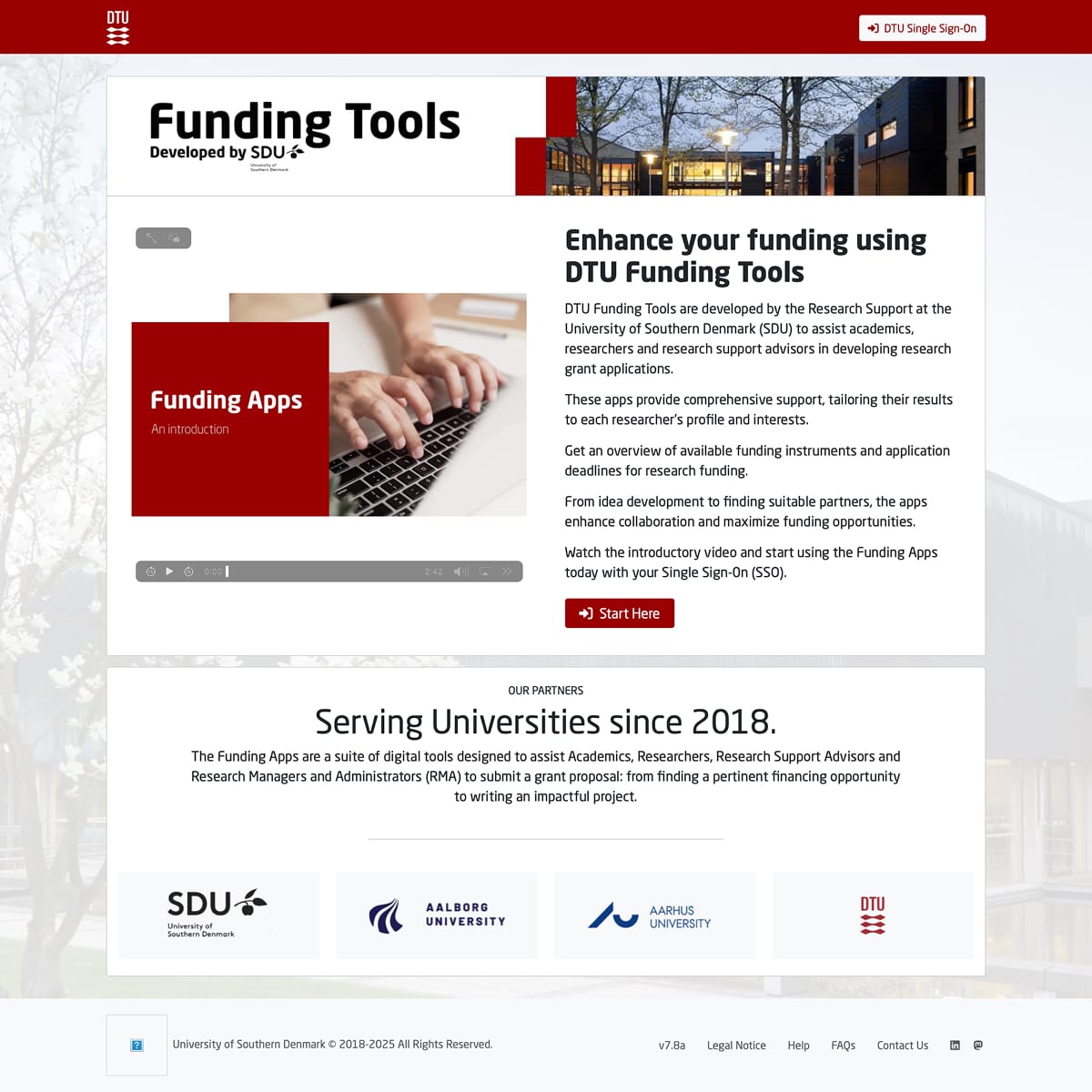
Technical University of Denmark (DTU) was the fourth Danish university to adopt the DTU Funding Tools in 2026.
Beyond the Code: A Genuinely Multidisciplinary Experience
Delivering the same ecosystem to five institutions taught me an essential lesson: writing the software is only one layer of the job. Each deployment was, in reality, a cross-functional endeavor that pulled me far outside the traditional perimeter of a developer.
Working Hand-in-Hand with Each University’s IT Department
No two campuses run their infrastructure the same way, and none of these platforms would have gone live without the daily cooperation of each university’s IT organization. Over the years, I collaborated across their full spectrum of métiers:
- Network and DNS: Configuring hostnames, subdomains, and routing rules so each platform integrates cleanly into the university’s own web estate.
- Security and Identity: Implementing federated Single Sign-On through national identity federations (SAML/OpenID Connect), passing institutional security reviews and penetration tests, and meeting Danish and European data protection requirements, GDPR included.
- APIs and Data Integration: Designing, exposing, and consuming REST interfaces to synchronize with internal PURE research repositories as well as external sources such as Pivot-RP and CORDIS.
- Operations and Reliability: Setting up CI/CD pipelines, monitoring, and the overnight batch jobs that keep every researcher’s grant matches up to date.
This meant speaking the language of network engineers, security officers, and system administrators alike — often within the same week, often across five different organizations at once.
A Product Shaped by Research Support Staff
The true product owners were never the IT departments. They were the research support officers of each university: the grant advisers, EU consultants, and project managers who live and breathe the funding landscape. Every module in the suite reflects their expertise. Through workshops, feedback sessions, and years of iterative dialogue, they translated the realities of Horizon Europe into requirements, and my role was to translate their requirements into software that fits the way they actually work — including the specific terminology and internal processes of each institution.
Building Bridges Across Working Cultures
As a French developer embedded in Danish institutions, I also had to become something of a bridge builder. Danish professional culture — its flat hierarchies, direct communication, and consensus-driven decision-making — differs in many ways from the traditions in which I was trained, and learning to work fluently within it took deliberate effort. Add to this the daily reality of international collaboration: consortium partners, reviewers, and stakeholders spread across Europe, with English as the working language and remote coordination as the norm. Seven years of this have made cross-cultural communication a core skill of the craft, as fundamental as any technology in the stack.
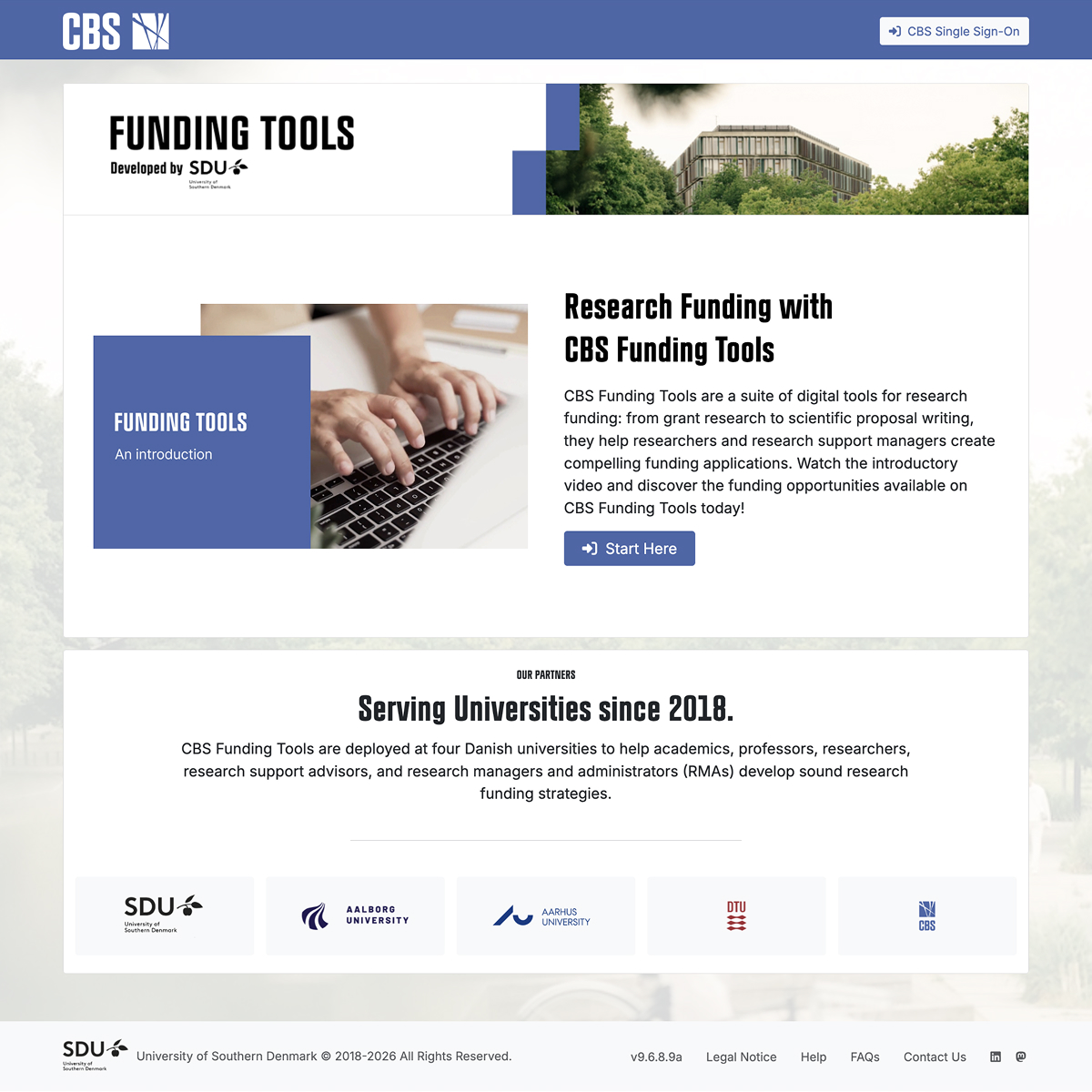
Copenhagen Business School (CBS) is the last Danish university that recently adopted the CBS Funding Tools in 2026.
From Solo Developer to Tech Lead: A Team Grows Around the Vision
Over the span of these seven years, something happened that nobody had planned at the outset: a team began to form around the project. Data scientists, web developers, and software engineers gradually joined, drawn to the initial vision — digitalising the métiers that facilitate academic collaboration — and eager to build new projects in its orbit.
With the team came new responsibilities. On top of my development assignments, I have increasingly assumed an informal role that sits somewhere between tech lead, CTO, and team manager:
- Recruitment: Designing recruitment tests and conducting hiring interviews to select developers and data scientists who combine technical rigor with an understanding of the academic world.
- Knowledge sharing: Hosting weekly thematic seminars in Odense to spread good coding practices, review architectural decisions, and keep the quality bar consistently high.
- Team leadership: Chairing weekly meetings that hold an international team together across three Western European countries — balancing working cultures, and communication styles into one coherent rhythm of delivery.
In hindsight, this is the natural extension of everything described above. The same continuity and depth that shaped the codebase now apply to people: building a team is not so different from building software — it requires a clear vision, honest feedback, and years of patient iteration.
The Freelance Advantage: Agility Meets Long-Term Vision
This seven-year journey highlights the distinct advantages of collaborating with a senior independent developer over an ever-shifting agency team:
- Full-Stack Ownership: From fine-tuning background NLP algorithms to designing clean, minimalist user interfaces inspired by Scandinavian aesthetics, every line of code is optimized for performance.
- Zero Context Loss: Over seven years, there has been no staff turnover and no changing project managers. The deep understanding of academic workflows and architecture has remained entirely intact.
- True R&D Partnership: This collaboration goes beyond standard client-vendor delivery. It is a continuous co-innovation process where we actively iterate to bring the latest technological advancements to the platforms.
The Road Ahead
Today, these tools actively support thousands of Danish researchers in securing millions of euros in funding to build the science of tomorrow — from Odense to Lyngby, from Aarhus to Aalborg, and now in Copenhagen. What began as a single university’s internal need has grown into a de facto national standard, and the journey is far from over.
Seven years. Five institutions. Countless métiers and working cultures. One developer. The proof that long-term, trust-based collaboration between an independent craftsman and world-class academic institutions is not only viable — it is the model that built this ecosystem.
